September 6, 2024
By Brian Johnson, Building Biologist and Licensed General Contractor
Chemicals Used in Building a Home: What They Are and How to Avoid Them
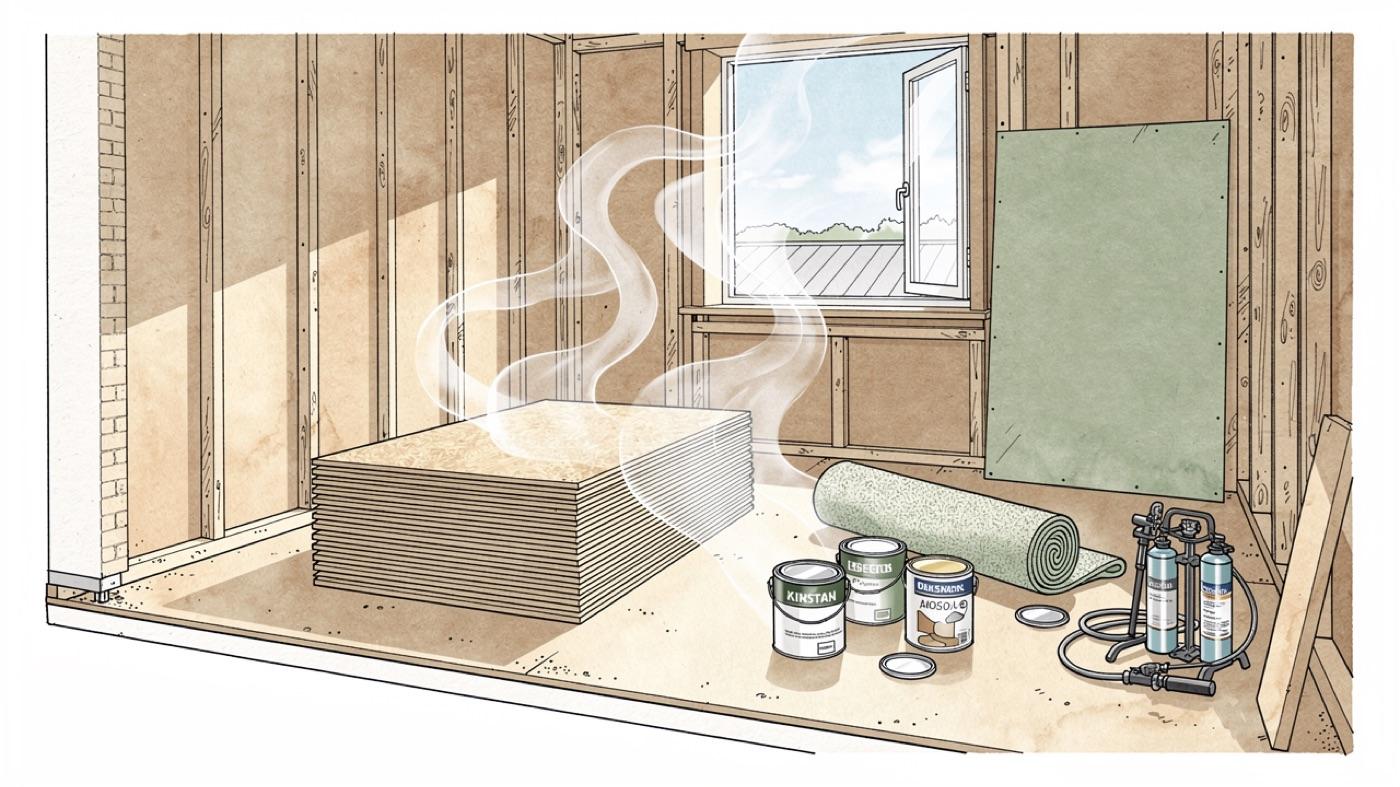
The chemicals used in building a home do not leave when the crews do. Formaldehyde in sheet goods, VOCs in paint and adhesives, flame retardants in foam, and biocides in coatings keep off-gassing into your air for months or years.
This guide explains where those chemicals hide, which certifications and databases actually help you screen them out, and the practices we use at SENERGY360 to build homes that start clean and stay clean.
Why chemical awareness matters
Many materials in construction today contain substances that can affect health and safety. Understanding the chemicals in your home before they are installed is the only reliable way to keep them out, because removing them afterward is expensive and sometimes impossible.
Transparency in material selection matters more than any single product claim. If a manufacturer will not tell you what is in a product, treat that as an answer.
Toxic chemicals used in construction and beyond
A review by the National Institute for Occupational Safety and Health in the late 1980s identified hundreds of toxic substances in common construction materials, some linked to cancer and reproductive harm. Some product categories are regulated by agencies such as the EPA and the Consumer Product Safety Commission. Many building products remain lightly regulated, and the rules that do exist focus on worker exposure during installation rather than the family living with the material afterward.
The same review looked at fragrance, which turns up in cleaners, air fresheners, and detergents that end up in the finished home. Of a partial list of 2,983 chemicals used by the fragrance industry, 884 were identified as toxic. According to the National Academy of Sciences, there is minimal or no toxicity data for 84 percent of fragrance ingredients.
That gap is why we start every project by choosing non-toxic building materials rather than trying to ventilate problems away later.
Certification and transparency platforms
Two programs go beyond emissions testing and ask manufacturers to disclose what a product is made of.
- Declare: a transparency label from the International Living Future Institute that lists a product's ingredients and flags chemicals of concern
- Living Building Challenge: a rigorous building certification whose Red List, built with the Healthy Building Network, names over 800 chemicals from 20 chemical families that a project must avoid
Key certification programs for construction materials
These certifications each answer a narrower question, so it helps to know what each one actually tests.
- GREENGUARD and GREENGUARD Gold: certify that a product's chemical emissions fall under set limits in a test chamber, and one of the first building material health programs, founded in 2001
- Cradle to Cradle: evaluates the whole lifecycle of a product, requiring materials that are sustainable and can be recycled or broken down into beneficial nutrients
- Green Seal: an independent nonprofit certification that verifies environmental and health criteria for products such as paints and cleaners
- FloorScore: an emissions certification specific to flooring and flooring adhesives
- Health Product Declaration: a standard format for manufacturers to disclose ingredients and their hazards
Chemical databases for material safety information
Several databases let you check a product or a chemical before it goes into your walls.
- UL SPOT: a product database that shows certifications and helps with LEED documentation
- Origin: searchable by certification, VOC standard, CSI division, or manufacturer, with over 140,000 materials listed
- SCS Global Services: verifies manufacturer claims such as recycled content, no added formaldehyde, lead safe, and carbon neutral across more than 30 certifications
- Pharos: a Healthy Building Network database that scores chemicals and building products on health and environmental hazards
- Toxnot: a chemical hazard dashboard covering over 40,000 substances and referencing more than 50 red lists
- GreenScreen for Safer Chemicals: a hazard assessment method whose List Translator flags hazardous chemicals and points to safer alternatives
- Environmental Working Group: a nonprofit that publishes consumer guides, reports, and a tap water database
Government health databases
For the chemistry itself, two public resources are worth bookmarking.
- ChemIDplus and PubChem, maintained by the National Institutes of Health, provide detailed physical, chemical, and toxicity information for individual chemicals. Compare a product's safety data sheet against them to see the recognized hazards of each listed ingredient.
- The Agency for Toxic Substances and Disease Registry maintains the Toxic Substances Portal, with plain-language profiles of harmful chemicals.
Hazard lists versus red lists
The two kinds of lists answer different questions. A hazard list groups chemicals by a specific endpoint, such as the IARC Group 1 list of proven human carcinogens and the Group 2A list of suspected ones.
A red list, also called a restricted substance list or precautionary list, is a list of chemicals to avoid. The Living Building Challenge Red List and the Perkins&Will Precautionary List are the two we use most.
What leading architecture firms avoid
Perkins&Will maintains a public Precautionary List of 25 categories of substances the firm avoids in its projects. It can be searched by chemical, health effect, or building division. The firm also keeps a list of known and suspected asthma triggers and a list of flame retardants.
Environmental protection standards
Two government programs are useful screening tools.
- EPA Safer Chemical Ingredients List: identifies chemical ingredients that meet the EPA's Safer Choice criteria
- California Proposition 65: requires businesses to warn about significant exposures to chemicals known to the state to cause cancer, birth defects, or reproductive harm
The EPA list uses a simple color code. A green circle means the chemical has been verified to be of low concern. A green half-circle means low concern but more data would strengthen the finding.
A yellow triangle means the chemical is the best in its class for its function but carries health hazards. A grey square means it is not acceptable in products seeking the Safer Choice label. A Prop 65 warning on a building product is a reason to ask what triggered it.
Where the chemicals actually hide
The EPA's page on volatile organic compounds and indoor air quality lists building materials and furnishings, glues and adhesives, and paints among the everyday sources of VOCs.
Concentrations of many VOCs are consistently higher indoors (up to ten times higher) than outdoors.
In our experience the biggest sources of formaldehyde and VOCs in a new home are the same on almost every job.
- Particleboard, MDF, and some plywood in cabinets, shelving, and subfloor
- Paints, primers, stains, and clear finishes, including the colorant added at the store
- Adhesives and caulks under flooring, behind tile, and around windows
- Spray foam insulation that was mixed or cured incorrectly, which is why we follow spray foam testing procedures
- Carpet backing, carpet pad, and stain treatments
- Vinyl flooring, vinyl wallcovering, and foam-based products with added flame retardants
The EPA's facts about formaldehyde name resins in hardwood plywood, particleboard and medium-density fiberboard as a main source, and note that breathing off-gassed air is the primary way people are exposed. Our guides to formaldehyde exposure at home and low-VOC building materials cover the swaps we make.
Best practices for safer construction
To build a healthier home, adopt these practices before the first material is ordered.
- Use certifications as a screen, not a verdict: GREENGUARD Gold, Declare, Cradle to Cradle, and FloorScore each tell you something different
- Check ingredients in Pharos, Toxnot, or UL SPOT when a product's data sheet is vague
- Prioritize transparency: choose products with full ingredient disclosure over products with only marketing claims
- Choose inert, mass-wall construction where you can, since FASWALL, ICF, and rammed earth walls have no cavity to fill and nothing to off-gas, as our FASWALL ICF block review explains
The precautionary principle
Our standard is the precautionary principle, stated at the 1998 Wingspread Conference. When an activity raises threats of harm to human health or the environment, precautionary measures should be taken even if some cause-and-effect relationships are not fully established scientifically. In practice that means a chemical with weak safety data does not go into a SENERGY360 home.
Safety during construction
When construction chemicals are unavoidable, protect the crew and the future occupants.
- Follow the manufacturer's instructions for handling, storage, and cure times
- Ventilate every space where adhesives, finishes, or foam are being applied
- Wear appropriate protective equipment such as gloves, goggles, and respirators
- Keep chemicals in their original containers in a secure, well-ventilated location
- Never mix products, and follow proper spill response procedures
- Allow finishes to fully cure, with active ventilation, before move-in
How a healthy home inspection checks the result
The Institute for Building-Biology and Ecology was founded in Germany in 1976 by Anton Schneider. It studies the impact buildings have on human health and promotes healthy, ecologically sound construction.
Its testing standard organizes an assessment into three categories.
- Category A: physical fields, waves, and radiation
- Category B: indoor air quality, pollutants, and indoor climate
- Category C: fungi, bacteria, and allergens
Each finding comes with recommendations to reduce the risk to an economically achievable level.
How SENERGY360 handles this
Every material on a SENERGY360 project passes through the healthy building materials principle of SENERGY360's 12 CORE Principles for Healthy Building Design before it is specified. We read the data sheets, we check the databases, and we test the results after installation.
If you are building or remodeling and want the chemistry handled from the start, our design and build team can carry the materials list for you. If you already live with a home that smells new long after it should, a Healthy Home Inspection will tell you exactly what is in the air and where it is coming from.