September 14, 2026
By Brian Johnson, Building Biologist and Licensed General Contractor
Plumbing Manifold Systems: How They Work and Why We Use Them
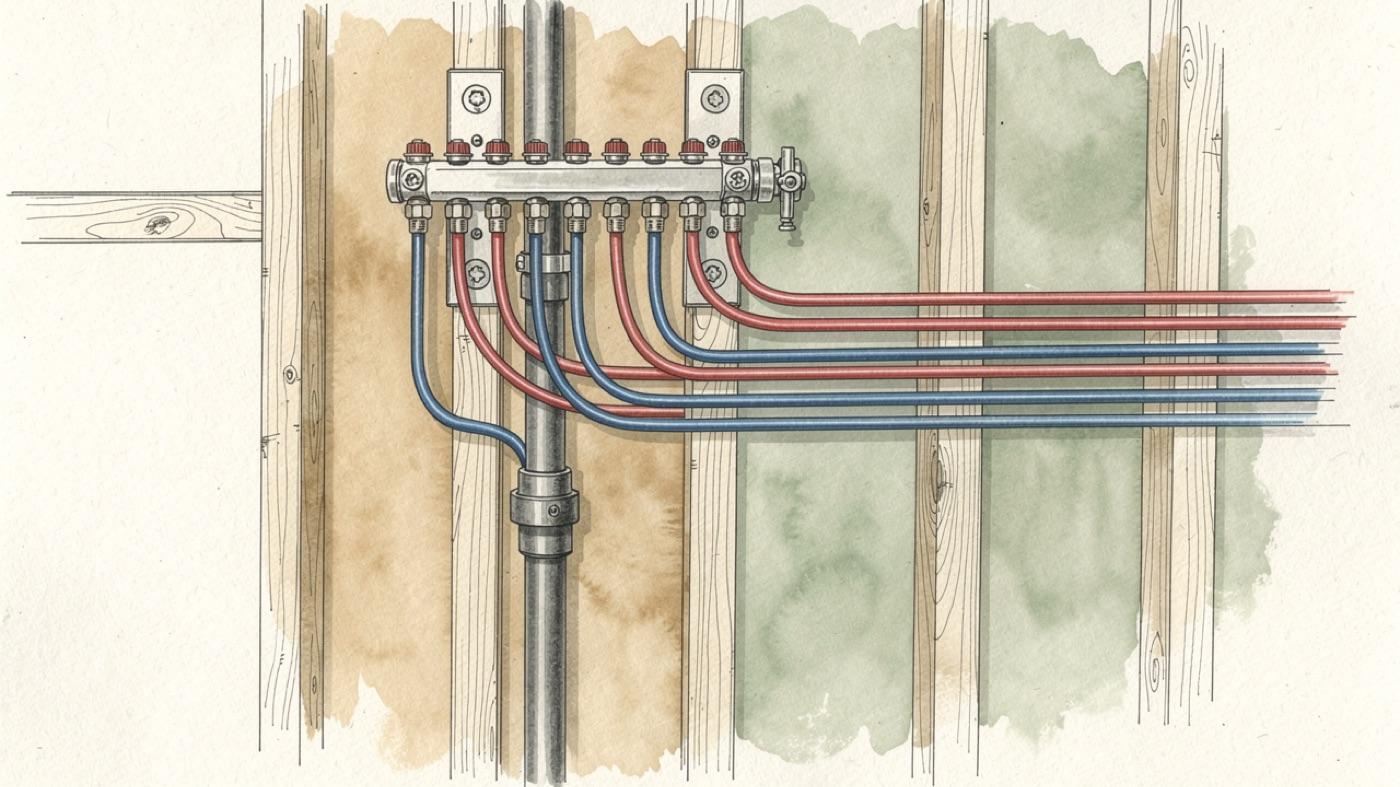
A plumbing manifold is the distribution hub of a modern water supply system. One main line feeds into a chamber, and individual lines run from that chamber to each fixture in the house. Every line has its own shutoff.
We specify a plumbing manifold on nearly every new build. It supports the healthy plumbing design principle in our CORE framework. It also makes the system easier to service, easier to isolate, and easier to keep clean.
How a plumbing manifold works
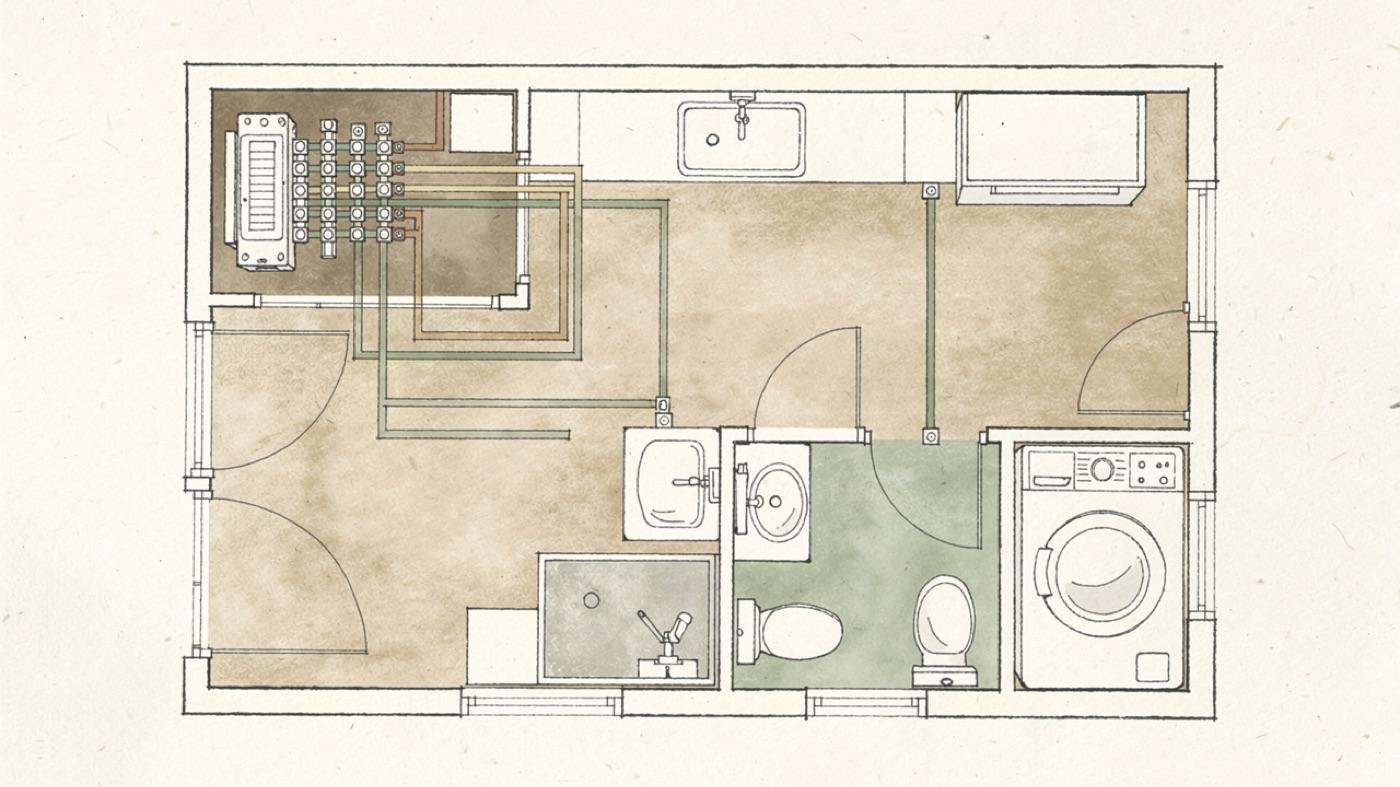
The structure is simple. A primary service line feeds a tubular chamber with multiple outlet ports. Each outlet port serves one component of the plumbing system.
One port might feed the cold water side of a master bathroom faucet. Another might feed the hot water side of a guest bathroom. Each fixture gets its own dedicated run, which plumbers call a home-run line.
The U.S. Department of Energy's Building America Solution Center describes the same layout.
A homerun manifold is typically set up with individual lines of cross-linked polyethylene (PEX) piping running from the manifold directly to each fixture without branching off. One benefit of this system is that you can shut off each side of each fixture individually without impacting any other fixture.
Hot and cold
Older and simpler systems sometimes used separate hot and cold manifolds. Newer manifolds, usually built from PEX, have separate hot and cold chambers in one unit.
Hot water comes from the water heater into the hot chamber. Cold water comes from the main service line into the cold chamber. The two never mix inside the manifold.
Why a manifold belongs in a healthy home
The obvious benefit is control. Shut off one fixture at the manifold and the rest of the house keeps running. There is no need to close the main and drain the whole system for a faucet swap or a repair.
The less obvious benefits are the ones that matter to us most.
- Fewer joints hidden inside walls, since each line runs continuous from manifold to fixture
- Fewer places for a slow leak to start, which means fewer hidden moisture problems
- Even pressure at every fixture, because no fixture is sharing a branch with another
- Faster hot water at each tap, since a dedicated line holds less standing water
- Easier flushing and maintenance of the whole system, one line at a time
Hidden leaks are one of the top causes of mold in a home. Continuous lines with no buried fittings remove much of that risk, which is why manifolds pair well with our mold prevention approach.
Pressure, freezing, and sizing
Modern manifolds can accept supply lines as small as 3/8 inch. They are built with safeguards that limit pressure drop and use fewer components than a branch-and-tee system.
Copper manifolds are trusted and cost effective. PEX systems are more flexible, resist freezing during cold snaps, and can be more energy efficient because the lines hold less water.
Types of plumbing manifolds
Manifolds come in many shapes and materials. The material and the connection type set them apart.
By material
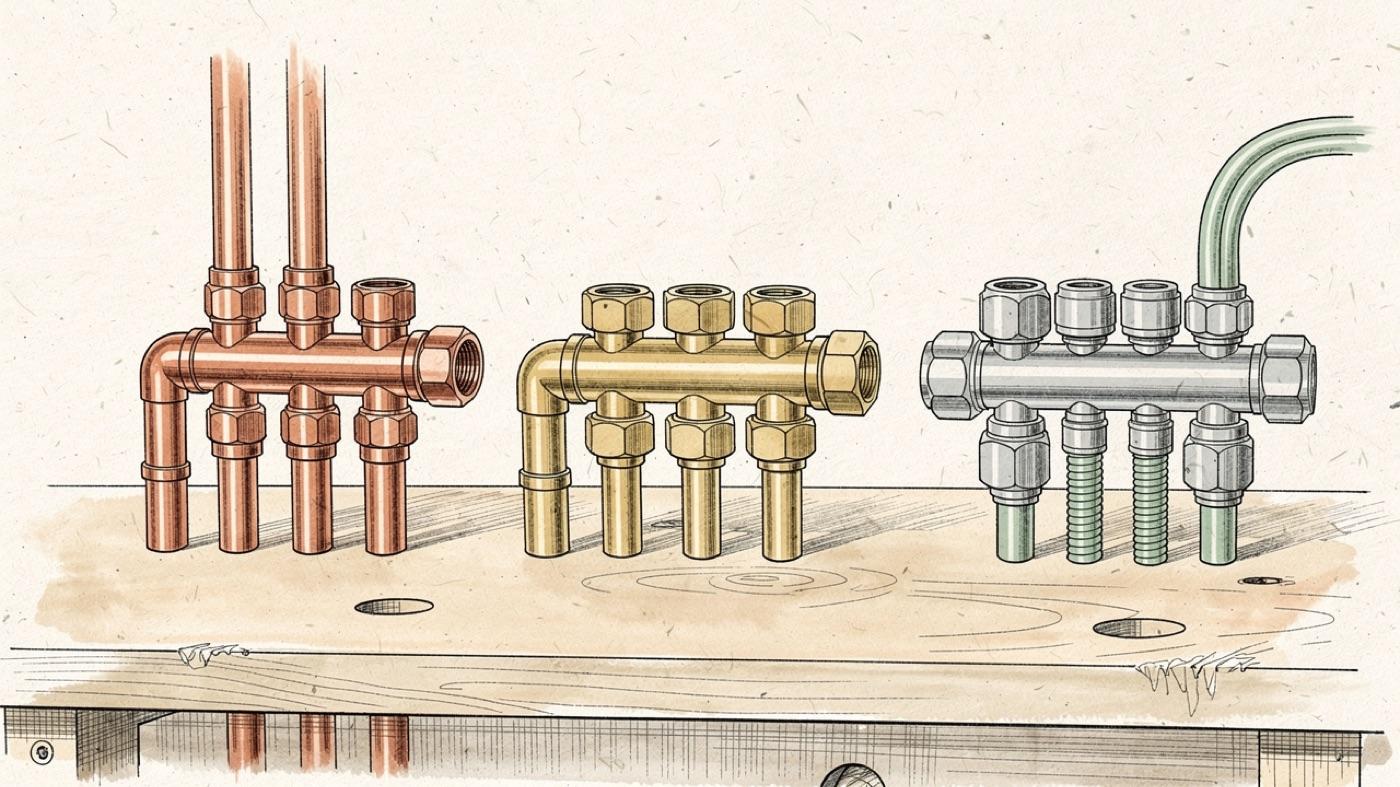
- Copper, brass, and bronze, which are the traditional choices
- PEX, or cross-linked polyethylene, which is the common modern choice
Material choice is a health question as much as a plumbing one. We cover it in depth in our post on non-toxic plumbing solutions.
If PEX is the question, our post on whether PEX is safe looks at the common claims one by one.
By connection type
- Compression manifolds, which use compression fittings and are among the most user friendly
- Crimp manifolds, which use crimp rings on PEX and are also simple to work with
- Copper sweat manifolds, the traditional soldered option
- PEX press manifolds, a hybrid that combines a PEX body with press fittings
- MANABLOC style manifolds, which control hot and cold in a single unit
Are plumbing manifolds necessary?
Essentially every modern residential plumbing system needs at least one manifold. Larger systems may need several.
For a small or medium home, a single PEX manifold is usually enough for the standard fixtures. Multi-unit buildings often use one primary manifold with mini-manifolds at each unit.
Where the manifold goes
In a single-family home, the manifold sits as close as possible to the incoming service line. That is usually a basement, a garage wall, or a ground-level utility closet.
A few placement rules make life easier later.
- Keep the manifold separated from other equipment so the shutoffs are easy to reach.
- Allow at least 18 inches of horizontal clearance and 36 inches of vertical clearance from the water heater.
- Mount it between wall studs where the design allows, with an access panel.
- Label every line at the manifold so anyone can find the right shutoff in seconds.
Manifolds in a SENERGY360 build
We plan the manifold location during design, alongside the water heater, the whole-house filtration equipment, and the recirculation loop if there is one. Getting those four in the right relationship shortens every line in the house.
Shorter lines mean less standing water, faster hot water, and less material in the walls. That is the kind of small decision that adds up to a healthier, more serviceable home.
Department of Energy building science guidance takes the same approach. It recommends designing hot water lines to store as little water as possible, with no more than 0.5 gallons stored between the water source and each point of use.